From the Cold War to the Desert: A Pivot in Intelligence
Updated: Jun 7
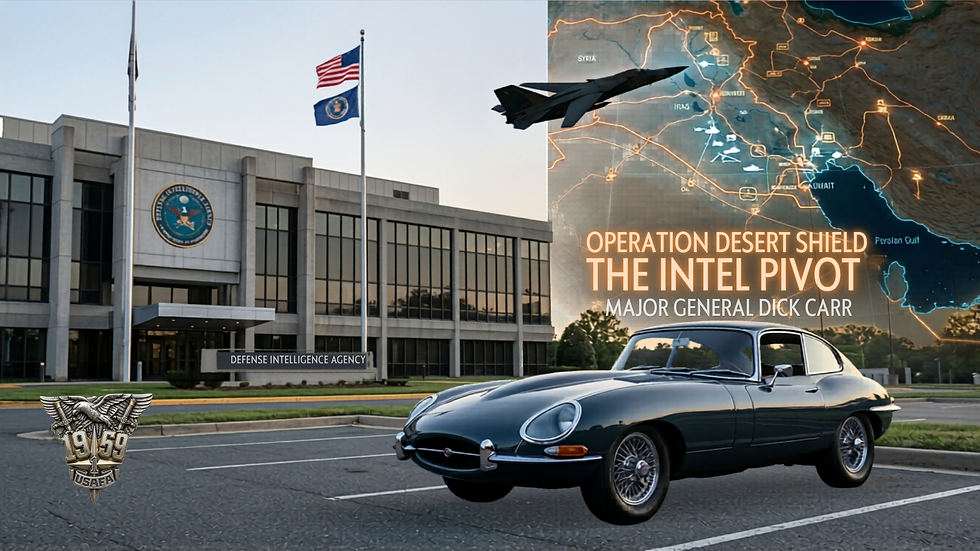
From the Cold War to the Desert
A Pivot in Intelligence
by Major General Richard "Dick" Carr, USAFA Class of 1959
In our previous look at '59er, General H.T. Johnson, we explored the "Aluminum Bridge" and the logistical miracle that made Operation Desert Shield possible. But even the strongest bridge can only carry the weight of the intelligence that guides it. As the U.S. shifted from the rigid but predictable structure of the Cold War to the volatile sands of the Middle East, it became clear that a different kind of bridge was needed: one built on insight, precision, and rapid adaptation.
Major General Richard "Dick" Carr (Class of ’59) recently shared a vivid memory of the moment the world shifted. That shift wasn’t theoretical. It arrived abruptly, personally, and without warning for those responsible for understanding the world’s most volatile regions. For Major General Carr, it began the moment he stepped into his new role at the Defense Intelligence Agency. It is a story of a Jaguar XKE, a weekend of intense study, and the realization that the U.S. military was looking at the wrong map.
The Friday Before the Storm
"I had just returned from Korea and was assigned as the Director of Foreign Intelligence for the Defense Intelligence Agency (DIA)," Gen. Carr recalls. "There were no homes available on Bolling Air Force Base at the time, so I left my wife, Jean, in Illinois. I drove to D.C. in my '64 Jaguar XKE with just a few clothes and moved into the VOQ (Visiting Officers Quarters)."
It was Friday afternoon when he actually had the opportunity to check in at the DIA building, only to find the building in a state of near-panic. He was informed that on Monday morning, he was to host and keynote a large international intelligence conference. He spent the entire weekend huddled with staff, studying the primary threat of the era and conference focus: Iran.
The Tuesday Turn
The conference began as planned on Monday. By Tuesday, everything changed. Iraq invaded Kuwait.
"We quickly ended the conference and gathered the staff," Carr says. "The first thing I learned was a stark reminder of our Cold War posture: we had 220 specialists studying Russia, but only four of them had an additional assignment to take interest in Iraq."
In that moment, the U.S. intelligence community realized it had been preparing for the wrong war. And thus, Operation Desert Shield began.
The "Mensure" of Success
The transition to Desert Shield and the eventual Desert Storm wasn't just about personnel; it was about technical precision. Gen. Carr highlights a critical lesson learned during a previous deployment to Ramstein Air Base involving the F-111 strikes on Gadhafi in Libya.
At the time, aircraft relied on Inertial Navigation Systems (INS)—internal compasses that "precessed" (lost accuracy) over long flights. To stay on target, pilots had to "update" their coordinates using a known landmark.
"The Mediterranean island where the F-111s updated their INS had not been mensurated by geodetic folks," Carr explains. In plain English: the exact geographic coordinates of that landmark hadn't been verified to a high enough degree of mathematical precision. "Because the 'update' point was slightly off on the map, the bombs did not hit correct targets. They instead bombed empty tents.
Building the Bridge Today
Major General Carr gives a cautionary warning based on his experiences. He reminds us that the success of any operation—whether in the air, on the ground, or across the globe—depends on the accuracy of the information that guides it. Whether it is having enough analysts focused on the right region or ensuring that our digital maps are "mensurated" to the inch, the bridge between the planners and the operators must be built on accuracy. The smallest oversight can ripple into strategic failure.
"Today, they really need us in the planning," Carr notes, "so that our military does not keep making the same sort of mistakes over and over." His story is a call to vigilance: to build the intellectual foundations that allow operators, planners, and commanders to act with confidence.
In every era, the mission depends on leaders who can see clearly, adapt quickly, and ensure that the bridge between intelligence and action is built on precision.
About Major General Richard "Dick" Carr

Major General Richard E. Carr is a distinguished member of the USAFA Class of 1959. A command pilot with over 7,500 flying hours, he is a veteran of the Vietnam War, where he flew over 200 combat missions, 900 flying combat hours, and earned the Distinguished Flying Cross and 12 Air Medals.
General Carr’s career has been defined by his expertise in intelligence and reconnaissance. Before serving as the Director for Foreign Intelligence at the DIA during the onset of Desert Shield, he held high-level positions including Chief of Staff for the UN Command/US Combined Forces Command in Seoul.
Today, General Carr remains deeply committed to his fellow service members. As a Vietnam veteran himself, he is actively involved in working with and supporting Vietnam Veterans organizations, ensuring that honor and the "bridge" of support for those who served remains strong. He was the Chairman of a committee who raised funds and built an exact replica of the Vietnam Wall in Punta Gorda, Florida. Today, he is President of a non-profit corporation formed for the perpetual care and maintenance of that Wall.

Reference Notes for Readers New to Military Language
DIA (Defense Intelligence Agency): The agency responsible for providing military intelligence to warfighters, defense planners, and policymakers.
VOQ (Visiting Officers Quarters): On-base temporary housing for military members.
Mensuration: The process of measurement. In military terms, "mensurated" coordinates are the exact, verified locations required for precision-guided weapons to hit their targets.
Geodetic: Relating to the scientific measurement of the Earth's geometric shape and orientation in space.


Comments