First Class by Bruce Callander
Updated: Aug 9
First Class
By Bruce D. Callander
Originally published in Air Force Magazine, June 1999 (Vol. 82, No. 6, pp. 56–61). Permission given to republish by Air Force Magazine.
The story of the Air Force Academy’s first graduating class is one of grit, improvisation, and historic firsts. On June 3, 1959, 207 cadets completed their academic journey and stepped into history as the Academy’s inaugural graduates. Their years at Lowry AFB and the still‑unfinished Colorado Springs campus forged a generation of officers who would go on to shape the Air Force, the space program, and the nation itself.
This reprint preserves Bruce Callander’s original narrative while integrating updated photos and improved readability for today’s digital audience.

On June 3, 1959, 207 Air Force Academy cadets completed their academic work and became, as a group, the academy’s first graduating class. Events on that day, 40 years ago this month, generated more than a few lasting images. Bradley C. Hosmer, the top graduate of that first class, received not only a diploma and Air Force commission, but also a Rhodes Scholarship. John G. Hayes Jr., still recovering from a skiing accident, limped to the stage on crutches. Flaye M. Hammond III came forward to the sound of classmates whistling the “Marines’ Hymn”; he was the lone graduate commissioned in another service. John M. Melancon received a special round of applause. He received his diploma but was medically disqualified from commissioning.

Their undergraduate years had been historic, but they weren’t lacking in difficulty. The Class of ’59 spent its first three years in refurbished World War II barracks at Lowry AFB, Colo. Their upperclassmen were stand-ins—USAF officers who had graduated from other academies. Their permanent uniforms and the campus at Colorado Springs still were works in progress.
By graduation day, however, the academy was up and running. The cadet wing had grown to more than 1,000 members, and the school had received accreditation. Its varsity football team had played in the Cotton Bowl and one of its members, Brock T. Strom, had been named All-American. What had been firsts for the Class of ’59 were becoming traditions for their successors.
Prosperous
In later years, the Class of ’59 prospered. Fifteen members became general officers, four of them retiring with four stars and one as the vice chief of staff of the Air Force. Robert D. Beckel served with the Thunderbirds, flew fighters in Vietnam, and returned to the academy as commandant of cadets. Later, he retired as a lieutenant general.
(Note of correction: 9.2% of the 207 graduated cadets from USAFA Class of 1959 were promoted to flag rank officers with 19 total generals.)

Hosmer completed his studies at Oxford, entered pilot training, and flew combat missions in Vietnam. He came back to Colorado Springs in 1991 as the academy’s first home-grown superintendent.
Karol J. Bobko joined the space program and commanded the first Challenger shuttle.

Robert E. Blake became the first in his class to shoot down a MiG. Both retired as colonels.
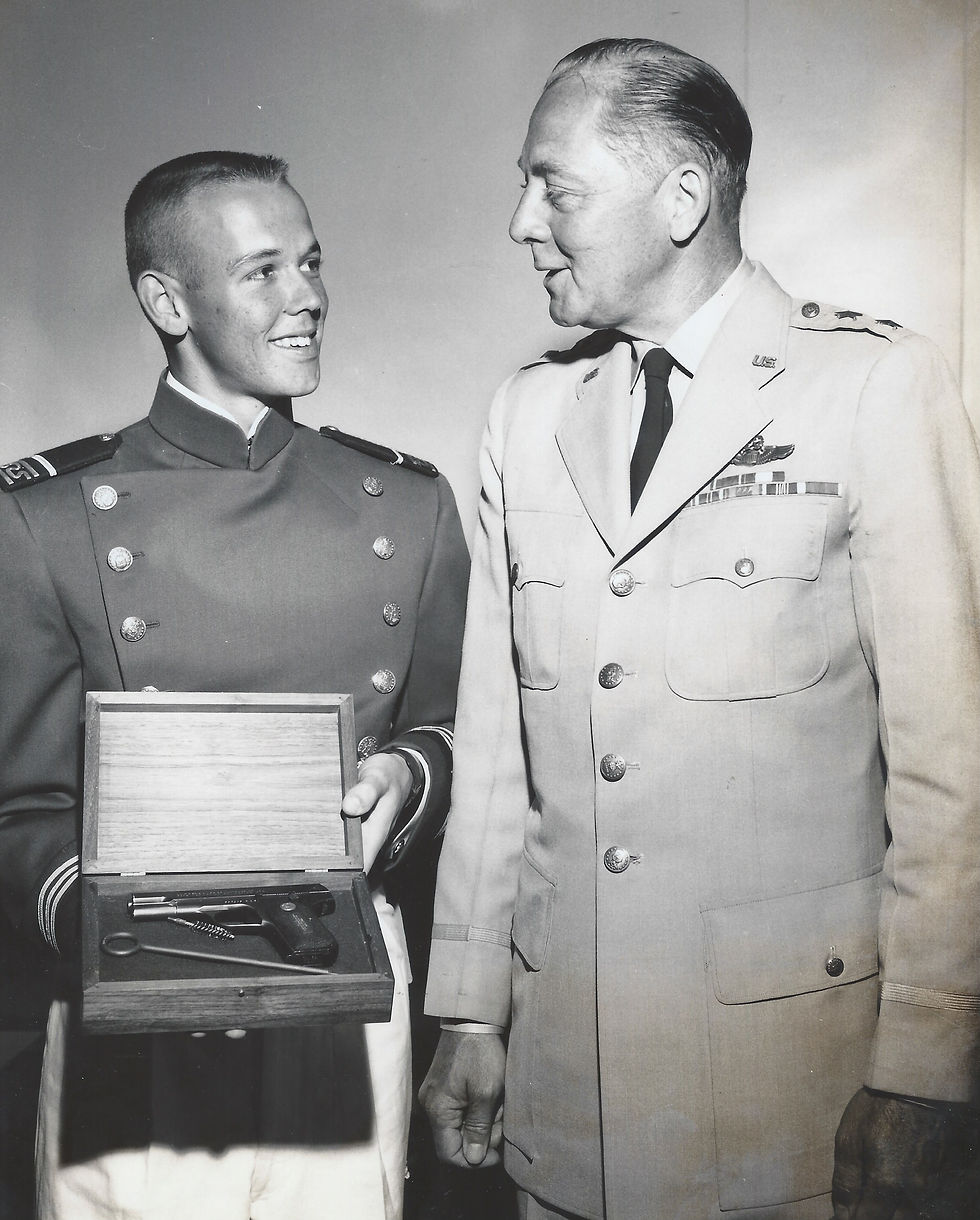
Harlow K. Halbower’s career was cut short in Vietnam. After winning 12 Air Medals and the Silver Star, he was shot down near Saigon, becoming one of four 59ers to be lost in Southeast Asia. A fifth was a returned prisoner of war.

Fifty-five graduates later resigned their commissions, several of them to become airline pilots. A total of 135 served until retirement; many of those have had second careers in fields such as real estate, investment counseling, management, and education. Several entered the ministry, another became an orthopedic surgeon, and a third became an attorney.
The dream of an academy for air officers preceded the reality by decades. Brig. Gen. William Mitchell proposed just such a separate school in the early 1920s. In 1931, the Army Air Corps consolidated all primary flight training at Randolph Field, Texas, and optimistically dubbed the base West Point of the Air. Before and during World War II, the Army Air Forces ran aviation cadets through a compressed version of academy-style training combined with flight instruction.
It was not until 1949, however, that the US took a major step toward creation of USAFA. Secretary of Defense James Forrestal named a board to take a broad look at the training requirements of all services. The group, headed by college presidents Dwight D. Eisenhower (Columbia) and Robert L. Stearns (Colorado), concluded in 1950 the Air Force required a separate institution.
It took another four years for Congress to authorize creation of the Air Force Academy. USAF Secretary W. Stuart Symington in the meantime named a site-selection commission, which considered 580 locations and narrowed the choice to three. Air Force Secretary Harold E. Talbott picked Colorado Springs in 1954. Randolph had been the sentimental favorite of some Air Force leaders, but Colorado offered a more isolated location and, to sweeten the deal, state leaders offered $1 million toward purchase of the property.
The first 306 cadets entered training at Lowry in July 1955. Their quarters were barracks and the dining hall was a standard GI mess, a far cry from today’s dorms and dining hall at Colorado Springs.
“I don’t think any of us had much basis for comparison,” said Hosmer, now a retired lieutenant general. “There were a few who came out of military high schools, but most of us had little prior connection with the military.”
Ready When You Are, C.B.
The cadet wardrobe also was largely government issue. A distinctive uniform had been in the works since 1952, but Air Force officials could not agree on a design. Talbott finally appealed to Hollywood director Cecil B. DeMille for help. When it became apparent the permanent uniforms would not be ready in time, however, the Air Force cobbled together a temporary outfit from standard-issue items, added shoulder boards to regulation shirts, and used the old Air Corps propeller-and-wings emblem for lapel and cap insignia.
Hosmer recalls that the hybrid ensemble caused some confusion even in active-duty circles. “We made a field trip to Langley [AFB, Va.] while my dad was a colonel teaching at Ft. McNair [D.C.],” he said. “He took me with him to some gathering in Washington where the people were mostly military. Later, my folks said that there was a lot of buzz about who that young fellow was in the odd uniform. The consensus was that I was a Russian ensign.”

The only new item in the clothing bag was a one-piece, sky-blue fatigue outfit with a cap modified from the one worn by the Brooklyn Dodgers. Dubbed “the bunny suit” by cadets, the coveralls proved impractical for field training and soon were abandoned for more traditional fatigues. Permanent cadet uniforms eventually were provided, as were hastily developed flags and interim heraldic designs.
Buildings were another matter. Congress had authorized construction in 1954 and the firm of Skidmore, Owings, & Merrill won the contract over 339 rivals. However, SOM’s first design was considered too modernistic. For example, an accordion-like design of the chapel drew from innovative architects such as Frank Lloyd Wright. Changes increased the cost and delayed construction so the actual work did not get under way until July 1955, when the first class already was in training at Lowry.

Hosmer said that, during their rare leisure moments, cadets would visit the site to see how the construction was going.
“I remember wondering about this huge girder-like construction, which was sitting on the ground,” said Hosmer. “It was just a great big box. It turned out that it was the roof for the dining hall. They built it and then pulled it up on the columns.”
The campus still was under construction when the class of ’59 moved in for its fourth year. The dining hall and recreation center were usable, the academic building was far enough along to be functional, and one wing of the dormitory building that was to be Vandenberg Hall was ready for tenants.
“The dorm was elegant compared with what we had had at Lowry,” said Hosmer. “The rooms had paneling and one whole wall was all window with these gorgeous aluminum fittings.”
Elegant they may have been, but not without their problems. “You get a very powerful wind coming through there on occasion,” said Hosmer, “and there were a number of design features that just weren’t compatible with it. Doors banged open, standing metal lights got ripped away. All that got corrected in time, but there was a lot of broken glass for a while.”
“Venturi Valley”
Wayne C. Pittman Jr., now a retired colonel, has similar memories. “The buildings had center-hinged doors, which the wind promptly tore off,” he said. “So, most of the year, we had plywood in the doors.”
Col. Robert E. Blake recalls that the cadets nicknamed the campus “Venturi Valley,” a reference to the venturi effect in which the intensity of winds increases as they pass through a narrow opening.
The cadets had little time to worry about such distractions, however. In addition to a standard Bachelor of Science curriculum that was heavily tilted toward engineering, USAFA cadets took navigation training. In those days, all cadets had to be physically qualified to fly and those who remained so graduated with navigator wings. Later, 186 of the graduates went on to pilot training and 168 became dual-rated.
Pittman went directly from the academy to a B-52 navigator assignment with Strategic Air Command. Later, he took graduate work in engineering, flew in RF-4s in Southeast Asia, and returned to the academy for three years as an instructor. His later assignments were as a navigator and commander.

“I thought the academy was perfect preparation,” said Pittman. “It was less technical than it is now. There may be some justification for the change, but I think a lot of us feel they have gotten overspecialized. We had the experience of a common education and it worked very well for us.”
Hosmer said, “Most of the class went to pilot training, so not many of us were dropped into the active force immediately. I would say we were really well-prepared for further training experiences. The hallmark of the academy was that you left the place equipped to handle pressure and well prepared to learn.”
Blake also went on to flying training and found his academy background helpful. “We knew a lot about aids to navigation and that sort of thing,” he said, “and, of course, we had had a lot of math.”
It was not all smooth sailing, however. Blake said, “When I got out into the ‘real Air Force,’ I know there was some resentment. We had been told to expect it, so we were careful not to act as though we were special. In flight training, some of my best friends were from other commissioning sources. Maybe academy grads did have an edge, but we knew that we still had to prove ourselves. Out there, a second lieutenant was a second lieutenant—regardless of where he came from.”
In addition to absorbing both military and academic subject matter, the first class developed many of the traditions that future classes would follow. One was the selection of a mascot. The choice narrowed to a tiger and a falcon. There was a show of hands; the bird won.

A more serious decision was the adoption of the honor code. Hosmer remembers the process as beginning with suggestions from Air Officers Commanding, active-duty officers in charge of cadet squadrons.
“There was a small group of AOCs from other military academies who had detailed knowledge of some of the honor codes in use at that time,” said Hosmer. “The head of that group, Capt. Bill Yancy, introduced the subject very early during our fourth-class summer. He said, ‘You will want to have one of these, so you guys have to decide what it’s like.’
“So, we had elections for honor representatives and they developed it, drawing on the advice of the AOCs and their own good sense of what one ought to be.”
The Hardest Part
“Of course, what we came up with looked a lot like the West Point code except that we formalized the non-toleration clause,” Hosmer continued. “That turned out to be the hardest part for the cadets to live with, then and now.”
Over the years, the code has undergone re-examination, particularly after cheating scandals shook the academy. Hosmer thinks the changes have been structural rather than philosophical. One major change was the creation of a rehabilitation system that allows cadets to have a second chance.
“The due process part has become laborious, now,” Hosmer added. “It takes much longer for honor cases to get settled, now, because the due process part has become meticulously careful, and that has both pluses and minuses. The minus is that there are cadets who hang around for many months with a cloud hanging over their heads and the case may go either way.”
These changes were inevitable, Hosmer said, as the makeup of the cadet wing itself changed.
“My crowd came out of a period when traditional values were fairly common across society,” said the retired general. “The situation is uneven today. What you see coming out of the coastal and urban areas, for example, is starkly different from what you see coming out of the Midwest. Also, the notion that it is important and valuable and rewarding to do something for a purpose that is bigger than yourself is not thick on the ground among today’s teenagers.”
He quickly added, “Bringing that variety of attitudes up to a common denominator of what you might loosely call character is, in my opinion, the core challenge for a military academy. And getting that right is one of the things we do more or less uniquely at military academies.
“On balance,” said the general, “the diversity of the classes has been a good thing. I think it is helpful in meeting the core problems that all the services are going to face over the next decade or so, which is surviving in a period when the culture as a whole doesn't support the military lifestyle.”
Pittman agreed the academy has changed but thinks it still does its core job well. Today's cadets are more sophisticated, he noted. In recent classes, cadets have designed, built, and gained hands-on experience by launching their own small satellites. Some, doubtless, will be astronauts.
By contrast, Pittman said, “I can remember in our third or fourth year when they suddenly had to crank in an astronautics program because of Russia’s Sputnik. No textbooks existed and we had to use one produced by our instructors. When we started, the book hadn’t been finished yet.”


Comments